
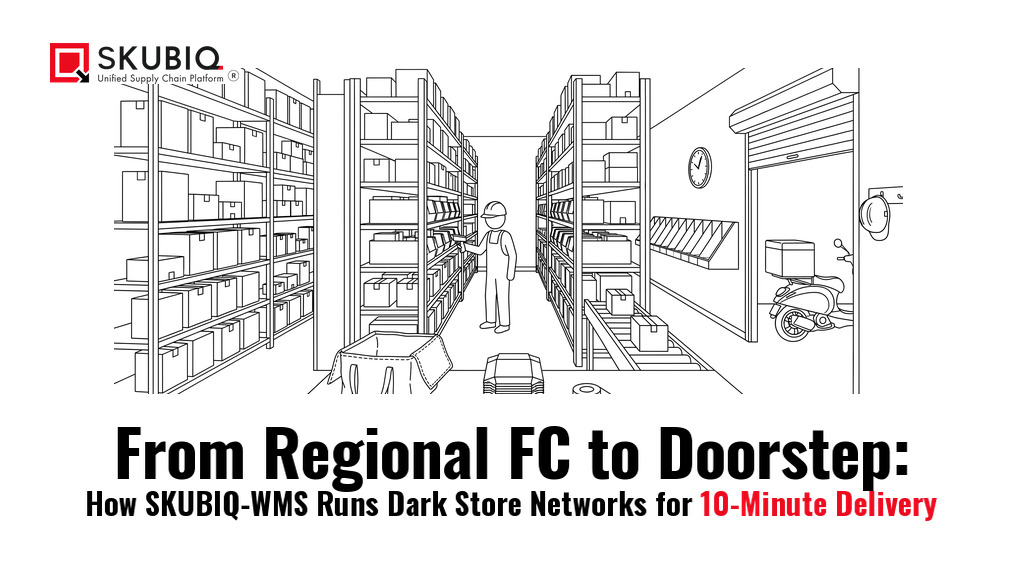
From Regional FC to Doorstep: How SKUBIQ-WMS Runs Dark Store Networks for 10-Minute Delivery
What a 10-minute promise actually changes
It is tempting to read quick commerce as a delivery problem: find the customer, find the rider, go. It is not. A ten-minute promise is a statement about floor space, and the people who wrote about it first were describing infrastructure rather than marketing.
The California Management Review put the position plainly in January 2026, in a piece on what India's 10-minute economy is doing to retail infrastructure.
The future of retail infrastructure is not being designed in the boardrooms of the biggest retailers in the world - it is being built in cramped 4,000-square-foot warehouses hidden in "dark stores".
California Management Review, The Dark Store Revolution: How India's 10-Minute Economy is Redefining Retail Infrastructure, 16 January 2026
The same article names the tension in a single sentence: customers want everything now, but traditional infrastructure was built for later. It also sets out the conditions that made the format work in India - a median age of 28.8 years, a population density of 1,100 people per square mile against 90 in the United States, and more than 750 million smartphone users on low data costs - and notes that a large, affordable gig workforce keeps last-mile costs far below Western markets, where high wages and suburban sprawl make ten-minute delivery economically hard.
The money follows the format. Unicommerce's 2026 setup guide for India projects sector revenue of US$5.58 billion in 2026, growing at a 12.82% compound annual rate to approximately US$10.20 billion by 2031, with 67.7 million users by 2031. Those are a vendor's projections rather than a regulator's figures, but they explain why every warehouse-software roadmap now has a dark-store module somewhere on it.
The operational consequence is easier to miss than the commercial one. In a facility built around a 48-hour promise, an unproductive minute is invisible - it is absorbed by the next truck. In a facility built around a ten-minute promise, the same minute is a missed service level, a cancellation, and a customer who buys somewhere else. That is why dark-store operations are a distinct discipline rather than a smaller version of warehouse management. This guide covers what a dark store actually is, the network that feeds it, the inventory rules that keep it honest, the compliance rules that shape it, and what SKUBIQ-WMS and SKUBIQ-TMS each do about it, and where SKUBIQ-LMS fits in.
What a dark store is - and what it is not
A dark store is a retail outlet that looks like a supermarket or convenience store but is not open to walk-in customers. It functions as a dedicated micro-fulfilment centre: employees or automated systems pick and pack items exclusively for online orders, dispatched for delivery within minutes or hours. Two words in that definition - "exclusively" and "dedicated" - are doing most of the work.
The practical difference shows up in the operating model. Base's 2026 guide for D2C brands describes dark stores as small, hyperlocal fulfilment centres of 1,500-4,000 sq ft spread across city neighbourhoods, never more than 2-4 km from the customer. When an order comes in, a picker grabs it off the shelf in under 3 minutes, and a delivery partner on a two-wheeler drops it at the door in 10-30 minutes.
Base also publishes the change table that brands argue with, and it is worth reproducing here because every row is a warehouse consequence:
| Traditional D2C assumption | How quick commerce changes it | The warehouse consequence |
|---|---|---|
| Sell your full catalogue | Only 5-15 fast-moving SKUs work | Slotting becomes a revenue decision, because a slow SKU is consuming pick face that a fast SKU needs |
| Warehouse 100-500 km from the customer | Stock must live 2-4 km from the customer | You need nodes, not one big building, and each node needs its own stock ledger |
| 1-3 day delivery window | 10-30 minute delivery window | The pick path, not the truck, sets the promise |
| Unboxing experience matters | Tamper-proof, compact packaging wins | Packing is a materials problem and a speed problem at once |
| National demand patterns | Every pin code is its own micro-market | Replenishment has to be local, not regional |
The three numbers that define a dark store
Three numbers describe the format, and they constrain each other:
- Floor area. Base puts a dark store at 1,500-4,000 sq ft and Omneelab at 2,000-4,000 square feet. Roughly 2,000 to 4,000 sq ft is the honest working band, and it is small enough that every square foot is either pick face or aisle.
- Catalogue breadth. Fretron describes a dark store as carrying a curated catalogue, typically 1,000-5,000 SKUs against 10,000+ in a supermarket; Omneelab puts the range at 2,000 to 5,000 SKUs. A narrow catalogue is what makes a sub-15-minute pick cycle possible.
- Radius. Base says never more than 2-4 km from the customer; CBRE describes dark stores as positioned within 2-3 kms of consumers. Inside that radius the two-wheeler is the only sensible last leg.
The third number is the interesting one. A 4,000 sq ft store holding two thousand SKUs can only work if the demand behind it is dense enough to keep the pick face busy - which is why the format clusters hard in metros and struggles to repeat itself in a low-density catchment.
The node hierarchy: regional FC, mother hub, dark store, doorstep
A dark store does not restock itself from a supplier's truck. Prozo describes the chain it runs on as regional FC to mother warehouse to dark store to last-mile delivery, and the sequence explains most of the inventory behaviour you will see in a live network.

The chain runs like this. The supply chain starts at regional fulfilment centres where inventory is received, quality-checked and pre-positioned from demand forecasts. Stock then moves via PTL routes to mother warehouses in metro and Tier-1 city clusters. From there the dark-store layer takes over, with automated replenishment logic monitoring real-time stock levels at every node and triggering replenishment when inventory drops below configured thresholds.
| Node | What it holds | What it decides | What breaks when it is wrong |
|---|---|---|---|
| Regional fulfilment centre | Supplier stock at pallet and case depth | Which SKUs get allocated to this network at all | The wrong assortment is 2,000 km away and will not arrive in a hurry |
| Mother hub | City-level stock in near-real-time demand | How fast a dark store can be refilled overnight | A node cannot be replenished inside its own cycle, so it runs on guesswork |
| Dark store | A narrow, fast-moving catalogue at pick face | Whether the promise is met at all | Phantom stock, a failed pick, or a cancelled order |
| Doorstep | Nothing - it is the end of the chain | Whether the customer tries again | A lost customer and a repeat-purchase cost |
Why mother hubs exist
The mother hub is the node people forget, and it is where most of the economics live. CBRE describes dark stores as compact, in-city micro-warehouses supported by larger peripheral mother hubs, and sizes the whole model: a network of roughly 7,800 stores across 100+ cities occupying around 27 million sq ft. CBRE projects that network growing to more than 12,000 stores by 2030, with dark-store stock reaching about 42 million sq ft and mother-hub stock about 33 million sq ft - roughly 75 million sq ft of cumulative urban logistics demand.
Three reasons the mother hub exists. First, a dark store cannot hold depth: it is optimised for pick face, so the replenishment quantity has to arrive in a format that can go straight to selling. Second, procurement and quality economics live upstream - a regional FC receives in full truckloads and can inspect, which a small node cannot. Third, one night-side operation feeding many micro-nodes is a different labour problem from staffing a hundred small sites separately.
CBRE also records where this is heading: 65-70% of stores remain concentrated in the top eight metro cities while expansion accelerates into tier-II and tier-III markets such as Jaipur, Lucknow, Surat, Coimbatore and Nagpur, and Indian q-commerce operators have attracted USD 8.94 billion in cumulative sector funding over the last decade, the second highest globally after the United States. The same report notes operators are transitioning toward franchised dark stores, 3PL logistics outsourcing, shared multi-brand fulfilment hubs, and partnerships with local kirana stores. That last trend is the strategically important one, because it means the node at the end of the chain is increasingly not owned by the same company as the node at the start - and a network that crosses ownership boundaries needs software that holds many clients, many catalogues and many rules at once.
Inventory at micro-node scale
Everything above is the frame. The part that decides whether the promise survives contact with a real order is inventory, and the AppAdvisor framing of it is the sharpest line written on this subject.
Dark-store economics depend on inventory accuracy. Ten-minute promises fail on phantom stock.
AppAdvisor, Quick Commerce & Dark Store Software India 2026, 14 September 2026
The same source is unsentimental about what actually fixes it: cycle counting, bin-level location and real-time sync matter more than AI features. That is a useful corrective, because the pitch decks all lead with the forecasting layer and the stores all fail on the ledger underneath it.
Omneelab describes the flow a dark store actually runs, and it is worth reading as a sequence because each step has an owner. A customer places an order on a q-commerce app; the WMS routes the order to the nearest dark store using order-routing optimisation; a picker inside the dark store receives a WMS-generated pick list and locates items rapidly; the order is packed and handed to a delivery rider; the rider delivers it to the customer's doorstep, often within 10 to 20 minutes.
Two numbers from that description explain the format's stress profile. Orders are small - typically 3 to 8 items - so there is no consolidation to amortise the handling cost; every order pays the full fixed cost of a pick, a pack and a ride. And pickers need to locate and collect items within 60 to 90 seconds, which means the pick path is a physical design constraint rather than a software preference. Omneelab also reports that demand forecasting in dark stores can reduce stockout risk by up to 35%, which is the vendor's own claim and should be treated as a direction rather than a number to put in a business case.
The replenishment trigger arithmetic
Dark stores replenish on a threshold, not on a schedule, and the arithmetic is simple enough to describe but easy to get wrong. Prozo states the inputs plainly: replenishment quantities are calculated using sales velocity data, day-of-week demand patterns, and seasonal trends, so that dark stores are stocked with the right products in the right quantities without overstocking or stockouts. Three inputs, and each one fails in a different way.
| Input | What it protects against | What goes wrong without it |
|---|---|---|
| Sales velocity | Stocking out on the SKUs that actually move | A slow-mix node that stocks evenly and starves on the top ten items |
| Day-of-week demand patterns | Weekend and weekday peaks arriving before the truck, not after | A node that is full on Tuesday and empty on Saturday morning |
| Seasonal trends | A heatwave, a festival or a cold snap changing the curve | Ice cream and chilled drinks in short supply exactly when the weather turns |
Omneelab's worked example of why this matters is a small one: instant noodle sales surge during late-night hours in Bangalore, and ice cream sales spike on hot afternoons in Mumbai. Neither is a forecast in the formal sense. Both are demand curves that a static reorder point will miss, and both show up as a missed sale on the same evening that the ledger still says the SKU is in stock.
This is where the warehouse layer has to do real work rather than bookkeeping work. SKUBIQ-WMS treats bin replenishment for hot SKUs and dynamic bin consolidations as named capabilities, and the second one matters more here than it does in a conventional warehouse: in a 3,000 sq ft node, the location of a fast SKU is the difference between a 60-second pick and a 3-minute walk, and the layout has to be re-optimised as the mix shifts.
FEFO, expiry and the temperature zone
A 2,000 sq ft store holding dairy, produce and packaged snacks is a different compliance object from a general warehouse, and the WMS requirements that follow from that are specific rather than generic. Fretron states them compactly.
For quick-commerce dark stores, the WMS must support extremely fast pick cycles (10-15 minutes) across a narrow SKU catalogue.
Fretron, Commerce and Supply Chain Glossary
The same glossary spells out what else changes: the requirements for a dark store are distinct from a traditional warehouse, with sub-15-minute pick cycles, no put-away complexity (flow-through receiving), temperature zones for dairy and produce, and direct integration with rider dispatch. Two of those four are worth a paragraph each.
Flow-through receiving changes the building. A conventional warehouse receives a pallet, inspects it, puts it away and retrieves it later. A dark store has nothing to put away, because it has no storage - every square foot is either pick face or aisle. A truck arrives, the cases are checked against the delivery note, and the saleable stock goes straight to the shelf.
Temperature zones change the layout. Chilled dairy and fresh produce cannot share a pick path with ambient packaged snacks without either a temperature-controlled room that eats square footage or a chilled pick face that eats pick time. Zoning also turns the pick path into a route rather than a scramble, which is why zone separation appears in Fretron's list of Indian warehousing requirements alongside GST-compliant inward and outward registers, multi-owner multi-client warehouses, and FMCG expiry-date management.
Expiry control follows from the same constraint. Prozo describes the dark-store WMS layer as handling bin-level tracking, FEFO (First Expiry First Out) rotation, expiry management, and real-time inventory visibility. In a small, fast-moving catalogue, expiry is not primarily a write-off problem - it is a picking problem. A node that picks FIFO hands out the oldest stock and holds the newest, so the newest stock expires before it sells; a node that picks FEFO without bin-level tracking cannot find the batch it is meant to pick.
Sortation at speed: the pincode burst
The order is picked. Now it has to leave. The step that most often breaks a ten-minute promise is not picking - it is sorting.

At a mother hub or a shared multi-brand hub, orders destined for one dark store arrive inside a mixed stream across many pincodes. Somebody has to turn that stream into per-rider loads while the rider waits on the loading line. If sorting happens after the rider has arrived - or is done by hand at the dock - the promise is already gone before the first kilometre.
Prozo and Fretron describe the requirement in different words and reach the same place: a dark-store WMS that orchestrates the pick and the handoff to the rider within minutes, with direct integration with rider dispatch as a core requirement rather than a bolt-on. The logic is straightforward once stated: the sort must be finished before the rider's arrival window, so the sort has to be driven by the arrival schedule, not by the order parcels happen to come off the belt.
This is also where the floor labour stops being uniform. The person who picks and the person who sorts have different cycle times, and the burst arrives in waves. SKUBIQ-WMS addresses this with pincode based automated sorting and AMR / AGV automated sorting - the direct answer to a mixed-pincodes stream, because the sort key is the destination and every parcel in the building carries one.
Last mile is a WMS and TMS problem
The rider is the last node and by a wide margin the most variable one, because it is the only one that is not inside your building and not on your payroll.

Both time and distance are tight. Base describes a delivery partner on a two-wheeler dropping the order at the door in 10-30 minutes, and CBRE places the dark store within 2-3 kms of the consumer. That leaves very little of the window for the leg that is actually outside the building - which is why the handoff has to be engineered rather than hoped for.
SKUBIQ-TMS covers the dispatch side of that with multi-carrier integration, dynamic dispatch, real-time GPS telematics, and an E-Commerce & Last Mile sector playbook. The combination matters more than any single feature: in a dense catchment the work is split across riders, in-house fleet and third-party carriers, and a static dispatch board cannot resolve that mixture at the moment a wave lands.
Carrier mix, dispatch and live ETA
The failure mode is a wave that arrives while every rider is already committed. Dynamic dispatch is the answer - reallocating the wave across the available fleet in real time rather than pre-committing it to a roster - and real-time GPS telematics is what makes that possible, because the system has to know where the riders actually are before it can reallocate.
A failed delivery is a second-order cost a dark store feels more sharply than a conventional warehouse. It is not just a wasted ride: it is a wasted pick, a wasted pack, and a unit that has to come back and be returned to available stock. Fretron's guidance is the operative detail - fast RTO reconciliation, with the returned unit back in available inventory within 24-48 hours - and a node with no put-away capacity has little room to absorb a unit that has nowhere to sit. Address validation at checkout and COD order verification, upstream of the promise entirely, are worth more here than in a warehouse that ships once a day.
Labouring a 10-minute promise
The 60-to-90-second pick target is a labour design decision before it is a software one. If the pick list is well sequenced and the SKU is where the picker expects it, the target is reachable; if either is false, the only way to hit it is to add people, which erodes the unit economics of the format.
SKUBIQ-LMS is built around exactly this: volume-driven labor, pack station balance that matches picking and packing capacity so the packing bottleneck does not appear at the end of shift, intelligent rostering, multi-site rostering, and performance analytics behind all of it.
Volume-driven labor is the first. A ten-minute promise is about capacity in a specific hour, and a dark store's demand curve is sharp rather than smooth. Pack station balance is the one teams get wrong first: a node with eight pickers and two packers has eight times the throughput problem and half the dispatch problem. Intelligent rostering is the third - shift patterns that follow the curve instead of a standard nine-to-six.
Multi-site rostering is the one the network makes unavoidable. A hundred dark stores of forty square metres are not a hundred separate labour problems; they are one rostering problem with a hundred locations, and a supervisor travelling between sites does not survive contact with a network spread across a metro and its outskirts.
Performance analytics closes the loop. A dark store that cannot see pick cycle time, pick rate and packing queue per shift will discover its bottleneck only when the customer does.
The KPI set that survives a dark-store audit
A dark store does not fail on one metric. It fails on a combination that looks healthy in isolation: inventory is accurate on paper, picking is fast, and yet orders are late. The table below is the set worth running, and the reason each one fails quietly is the reason it is on the list.
| Metric | What good looks like | Why it fails quietly |
|---|---|---|
| Inventory accuracy | Bin-level records that survive a cycle count on the fast movers | Accuracy is measured on the slow-moving SKUs, which are the ones nobody counts |
| Stockout rate on top SKUs | Low and stable, measured per node rather than per network | Network-average accuracy hides one bad node until it is on social media |
| Pick cycle time | Consistent with the 60-to-90-second locate-and-collect target | Average pick time improves while the worst-picked item gets worse |
| Pick to pack handoff | Short and stable across the shift | The queue moves to the end of shift instead of disappearing |
| Sort-to-rider ready | Completed before the rider's arrival window | Sorting is done by hand at the dock, off the clock |
| First-attempt delivery | High, with failure reasons classified | Cancellations are counted as successful orders until the refund arrives |
| RTO reconciliation time | Back inside available inventory within the agreed window | Returned stock is quarantined and the node quietly shrinks |
| Expiry write-off | Small and stable, with FEFO evidence | Write-offs are attributed to the category rather than the picking rule |
The order of that list is the order of the discipline. Inventory accuracy first, because nothing above it is meaningful if the ledger is wrong. Cycle time second, because a promise is a time. Everything else is a consequence.
Compliance and the two rules people forget
Two regulatory facts shape how a quick-commerce network is built, and both are routinely discovered late.
The first is the foreign-investment constraint on inventory-based e-commerce. AppAdvisor records that DPIIT's e-commerce FDI policy, Press Note 3 of 2016, does not permit FDI in the inventory-based model of e-commerce. A dark store is exactly that model, so the constraint reaches all the way down to the node - and it is one of the reasons CBRE observes operators transitioning toward franchised dark stores, 3PL logistics outsourcing, shared multi-brand fulfilment hubs, and partnerships with local kirana stores. The structure of the network is shaped by the regulation.
The second is food registration. AppAdvisor notes that food businesses, including dark stores holding food, need FSSAI registration or licences under thresholds revised from 1 April 2026. A node that was registered before that change may need to be re-registered against the revised thresholds, and the timeline for that is a project plan, not a form.
Two more requirements belong on the same list because they are unglamorous and non-negotiable. GST-compliant inward and outward registers are required at every node that receives and dispatches, and a network with a hundred nodes has a hundred registers to reconcile. And zone separation for different principals - separate stock, ownership and reporting for each brand in a shared hub - is what makes a shared multi-brand dark store commercially possible at all, and it is the requirement a multi-client warehouse system has to enforce rather than merely support.
What SKUBIQ does - and what it does not do
The honest framing comes first, because this article is not an announcement. SKUBIQ does not operate dark stores. SKUBIQ sells warehouse, transport and labour management software. If you run a quick-commerce platform, SKUBIQ is the layer your network runs on; if you are a D2C brand supplying one of those platforms, it is the layer you run your own stock and replenishment through. Either way, this is not news that SKUBIQ has opened a 2,000 sq ft store somewhere.
In SKUBIQ-WMS the dark-store case lands on multi-location and multi-warehouse support, bin replenishment for hot SKUs, dynamic bin consolidations, pincode based automated sorting, AMR / AGV automated sorting, dynamic slotting optimization, wave and batch picking optimization, and cross-docking capabilities. The multi-location point deserves the emphasis: a dark-store network is not one warehouse with a few branches, it is dozens of small locations a supervisor cannot visit, so the system has to carry the operational truth rather than the reporting layer.
In SKUBIQ-TMS, the relevant surface is multi-carrier integration, dynamic dispatch, real-time GPS telematics, and the E-Commerce & Last Mile sector playbook, alongside a 3PL and freight forwarding profile for multi-client operations. The last-mile integration is the piece that closes the chain, because in a dark store the handoff to the rider is a system event rather than a human shout across a dock.
In SKUBIQ-LMS, it is volume-driven labor, pack station balance, intelligent rostering, multi-site rostering, and performance analytics - the roster and the floor of a network that has to be staffed in dozens of places at once.
For teams running it as a single deployment rather than three, SKUBIQ's SaaS WMS for India covers 3PL functionality across multiple warehouses, auto data capture, third-party API and eCommerce integration, reporting and dashboards, and last mile delivery integration, with channel connectors for Shopify, Amazon and Magento. How the modules are packaged is set out on the SKUBIQ WMS plans page, and the platform questions that come up most often are collected in the SKUBIQ FAQ.
Read as a set, the dark-store case is four claims rather than one. Multi-location because the network is many nodes. Multi-warehouse because a mother hub and a dark store hold different things at different depths. Last-mile integration because the promise ends at a rider's handlebar. And labour, because a ten-minute promise is a staffing plan before it is a software feature.
How to start: a staged rollout
The failure mode is opening dark stores before the warehouse layer is right. A network whose nodes each carry their own inventory errors will not fix itself by expanding, because every new node adds another ledger to reconcile and another set of rules the network cannot enforce centrally. The working version changes measurement and configuration first, and adds nodes afterwards.
| Window | Focus | What you should be able to show at the end |
|---|---|---|
| Days 1 to 15 | Measure one node. Cycle-count the top movers, find the gap between the ledger and the shelf, and time a real pick end to end | A baseline for inventory accuracy, pick cycle time and pick-to-pack handoff at a single site |
| Days 16 to 30 | Fix the data. Correct the item master, define the fast-mover slotting rules, and set the replenishment threshold inputs from real velocity | A clean item master for the top movers and a replenishment trigger you can defend |
| Days 31 to 50 | Encode the rules. Configure FEFO, temperature zones, zone separation for each principal, and the pick-to-pack workflow | A configured node that a new picker can run without judgement |
| Days 51 to 70 | Connect the chain. Sort to pincode, hand off to dispatch, and reconcile the rider's actual arrivals against the schedule | Sort-to-rider-ready time measured, and the wave arrival profile documented |
| Days 71 to 90 | Add the second node on the same configuration, then review the KPI set against the baseline | A before-and-after number per site, and a template that the third node can be copied from |
Two disciplines make it stick. Protect the data: if the item master changes and the slotting rules do not, the pick path quietly gets worse while every report still looks fine. And close the loop: a node with no feedback from the floor is a configuration, not a system. SKUBIQ support is the right door to pressure-test the setup against your own operation.
Before you commit to anything, ask the questions that separate a working implementation from a demonstration:
- Can the same configuration run at a hundred locations, with each principal's rules and stock held separately?
- What happens when the item master is wrong - does the pick block, or does the node pick a substitute and absorb the error?
- Does the system know the difference between reserved and available stock at bin level, and can a cycle count correct both?
- Can it enforce FEFO and temperature zones as rules rather than reporting them after the fact?
- Does the sort run to the rider's actual arrival window, and can you see the queue building before it becomes a missed delivery?
- What is the audit trail - can we see inventory accuracy and pick cycle time per site, per shift and per principal?
The discipline is straightforward once it is separated from the hype. Inventory accuracy first, because a ten-minute promise fails on phantom stock before it fails on anything else. Then the pick path, then the sort, then the roster, and only then more nodes. SKUBIQ's contact team is where that conversation starts.