
One Weight, Three Consequences: Truck Weight at the Dock
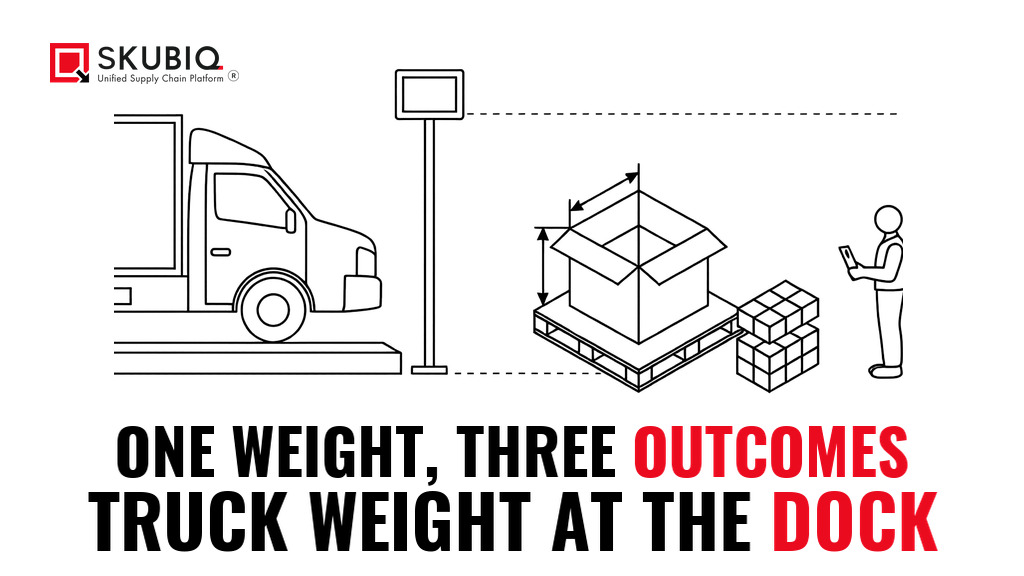
A truck arrives at your dock with one number that nobody has agreed with anybody yet: what it weighs. Not the SKU count, not the pallet count, not the number of cartons a picker put on it - the weight, read on the platform scale, written once on the dock sheet and handed to the driver.
That single number then travels into three separate systems, and each does something different with it. The freight invoice bills against it, because chargeable weight is what a transporter is entitled to charge for. The law compares it against a limit written into the vehicle's registration certificate, and can stop the vehicle from moving. The toll plaza multiplies the fee because of it, under rules that changed on 15 April 2026 and now punish an overloaded vehicle at twice or four times the base rate depending on how far over it is.
One weight, three consequences
The reason this is worth treating as a single subject rather than three separate ones is that the three systems share a clock but not a spreadsheet. The invoice is settled weeks after the truck left. The challan is issued at a weighbridge ten kilometres from the destination. The toll is deducted at a plaza the driver passed at 04:10 in the morning. A weight captured casually at the dock and reconciled by hand three weeks later cannot support any of those three decisions.
| Consequence | Who applies it | What the number decides | What goes wrong if it is wrong |
|---|---|---|---|
| The freight invoice | Your transporter, or your own 3PL billing team | Chargeable weight - the higher of actual weight and volumetric weight | You are billed on a weight that was never weighed, or the transporter re-weighs at destination and collects the difference |
| The legal limit | An officer authorised under Section 114 of the Motor Vehicles Act | Whether the laden weight exceeds the gross vehicle weight on the registration certificate | A challan under Section 194, plus the load being off-loaded at the roadside |
| The toll multiplier | The toll plaza operator, on National Highways | The multiplying factor applied to the base user fee | Double or four times the base fee at every equipped plaza on the route |
All three are downstream of the same physical act - the truck sitting on a scale with its load aboard. A dock-side weighbridge is therefore not a compliance chore bolted onto the outbound process. It is the point where all three outcomes are still one number. Get the number wrong at the dock and you have not made a small clerical error: you have created three. The invoice is wrong, the vehicle is exposed to a challan and an on-road unload, and every equipped toll plaza on the route charges the multiplier.

Consequence one: what the invoice is actually built on
The number that reaches the invoice is not the weight on the scale. It is the chargeable weight, and for road freight in India that is the higher of two measurements: what the goods actually weigh, and what their volume converts to under the transporter's volumetric rule. Navata Road Transport states the rule plainly: freight is calculated on actual weight or volumetric weight (CDM), whichever is higher, with additional charges for special services such as door delivery, insurance or express delivery [Navata]. Their worked example makes the mechanics concrete: a carton of 100 cm by 60 cm by 50 cm that actually weighs 90 kg is 300 CDM in volume, which is 150 kg on the Andhra Pradesh factor of 2 CDM equals 1 kg, or 120 kg on the divisor of 2.5 used for Tamil Nadu, Karnataka and Pondicherry - and the 90 kg actual weight is not billed at all [Navata].

CDM means cubic decimetre: a 10 cm by 10 cm by 10 cm block, one litre of space. Many Indian part-load transporters instead quote in cubic feet, with one cubic metre equal to about 35.31 CFT, and bill per CFT or per kg, whichever comes to more [Navata]. The factors differ between transporters and states, which is why the number has to be captured per consignment against the rules of the transporter that will carry it, rather than assumed once for the whole network.
| Volumetric rule | Conversion | What 300 CDM bills as | Against a 90 kg actual weight |
|---|---|---|---|
| Andhra Pradesh | 2 CDM = 1 kg | 150 kg | Volumetric wins; the actual weight is not billed |
| Tamil Nadu, Karnataka, Pondicherry | CDM divided by 2.5 | 120 kg | Volumetric wins; the actual weight is not billed |
| Dense cargo in the same carton | No volumetric uplift | 90 kg | Actual weight is billed |
| Cubic-foot quoting | About 35.31 CFT per cubic metre | Billed per CFT or per kg, whichever is higher | Same rule, different unit - the factor has to be read off the quote |
Two operational consequences follow, and both are avoidable with the same record. First, the measurement has to be taken as packed for travel, including pallet, crate or protruding parts, because the transporter may re-measure. Second, the transporter's booking terms reserve the right to re-weigh, re-measure and re-classify a consignment at the destination and to collect any amount omitted or undercharged before delivery [Navata]. A dock that measures and declares accurately at booking does not pay that correction twice.
One record, two consumers
The dock measurement is the natural place to close this gap, because the transporter's own rule makes the declaration at booking the point at which the chargeable weight is set. SKUBIQ's SaaS Warehouse Management System for India monitors the stock reservation and conducts the vehicle load planning, and lets you create dispatch dock assignments and delivery [SKUBIQ SaaS WMS for India]. The volumetric factor itself belongs in the configuration, not in the operator's head, because it differs by transporter and by state.
Consequence two: the legal limit lives on the registration certificate
The second consequence is a number you do not control at all, and it is worth being precise about what it is. Section 113 of the Motor Vehicles Act, 1988 sets the limits of weight and limitations on use. Section 113(3) is the operative provision: no person shall drive or cause or allow to be driven in any public place any motor vehicle or trailer whose unladen weight exceeds the unladen weight specified in the certificate of registration of the vehicle, or whose laden weight exceeds the gross vehicle weight specified in the certificate of registration [Motor Vehicles Act, 1988].
So the legal limit is not a generic number for the vehicle class. It is two specific figures attached to one specific registered vehicle - the unladen weight and the gross vehicle weight - and the payload you may legally carry is the difference between them. That is why a loading plan that works for one truck does not transfer to a substituted vehicle: a pallet plan that fits comfortably inside a 14-tonne GVW can put a 9-tonne GVW truck over its limit on the same lane, and nothing in the manifest will tell you so.
Section 113(1) also lets the State Government prescribe the conditions for the issue of permits for transport vehicles and prohibit or restrict their use in any area or route [Motor Vehicles Act, 1988], and Section 113(2) requires that a vehicle not be driven in a public place unless fitted with pneumatic tyres [Motor Vehicles Act, 1988]. It is a short section that does a lot of work, and Section 194 is where its breach is priced.
Why a substitution is a compliance event
Because the limit is attached to one registered vehicle rather than to a class, any change of vehicle in the plan is a change of legal limit. SKUBIQ-TMS validates axle configuration, weight distribution and equipment matching before dispatch [SKUBIQ-TMS], so the truck that is loaded is the truck that is planned.
Section 114: the power to weigh, and the power to make the driver unload
The authority to stop a goods vehicle and weigh it is Section 114. An officer of the Motor Vehicles Department authorised in this behalf by the State Government, if he has reason to believe that a goods vehicle or trailer is being used in contravention of Section 113, may require the driver to convey the vehicle to a weighing device within a distance of ten kilometres from any point on the forward route or within a distance of twenty kilometres from the destination of the vehicle [Motor Vehicles Act, 1988]. Two features of that sentence are routinely misunderstood. The window is short and measured from the route and the destination, not from the point of detection, so the weighing has to happen close to the end of the journey. And it is the officer, not a private weighbridge operator, who decides.
If the weighment shows the vehicle contravening Section 113 regarding weight, the officer may by order in writing direct the driver to off-load the excess weight at his own risk and not to remove the vehicle from that place until the laden weight has been reduced [Motor Vehicles Act, 1988]. The officer must also endorse the relevant details of the overloading on the goods carriage permit and intimate that endorsement to the authority which issued the permit [Motor Vehicles Act, 1988]. That last step is the one that hurts longest: the overloading is recorded against the permit itself, so it is not a one-off event on one trip but a mark that follows the vehicle and the paperwork.
The 2019 amendment widened who may be appointed to exercise this power. Section 41 of the Motor Vehicles (Amendment) Act, 2019 amended Section 114(1) so that the officer may be any person authorised in this behalf by the State Government, not only an officer of the Motor Vehicles Department [Motor Vehicles (Amendment) Act, 2019]. In practice that means a highway authority, a police officer or a contractor can be empowered to stop and weigh a goods vehicle, which extends the number of places at which an overweight load can be caught.
Section 194 after 2019: what an overload costs now
The penalty for contravening the weight limits has been raised more than once, and the current figures are materially different from the ones most reference material still quotes. As the Supreme Court recorded in Paramjit Bhasin and Others v Union of India, Section 194 as it then stood provided a fine of not less than two thousand rupees and an additional amount of one thousand rupees per tonne of excess load, and made refusal to weigh punishable with a fine which may extend to three thousand rupees [Supreme Court of India].
Section 78 of the Motor Vehicles (Amendment) Act, 2019 - the Motor Vehicles (Amendment) Act, No. 32 of 2019, published in the Gazette of India on 9 August 2019 - rewrote that. The word "minimum" was omitted from Section 194(1), and the penalty became a fine of twenty thousand rupees and an additional amount of two thousand rupees per tonne of excess load [Motor Vehicles (Amendment) Act, 2019]. A proviso was inserted: such motor vehicle shall not be allowed to move before such excess load is removed or is caused or allowed to be removed by the person in control of such motor vehicle [Motor Vehicles (Amendment) Act, 2019]. The old allowance of three thousand rupees for refusing to weigh became a fine of forty thousand rupees [Motor Vehicles (Amendment) Act, 2019].
A new Section 194(1A) was inserted for the separate offence of loading that extends laterally beyond the side of the body, or to the front or the rear, or in height beyond the permissible limit: a fine of twenty thousand rupees, together with the liability to pay charges for off-loading of such load, and the vehicle may not move until the load is arranged [Motor Vehicles (Amendment) Act, 2019]. The bare 1988 Act still carries the pre-2019 figures, so an operator reading it today will be looking at penalties that no longer apply. The Press Information Bureau's summary notes that the relevant sections were made applicable from 1 September 2019 and records section 78 as enhancing various penalties for driving a vehicle exceeding permissible weight [Press Information Bureau].
One more clause is easy to miss and expensive to ignore. Section 199B, inserted by the same Act, provides that the fines in the Act shall be increased by such amount not exceeding ten per cent in value of the existing fines, on an annual basis on 1st day of April of each year from the date of commencement of the Motor Vehicles (Amendment) Act, 2019, as may be notified by the Central Government [Motor Vehicles (Amendment) Act, 2019]. The statutory figures are therefore a floor that moves upward once a year, and a penalty calculation built on the bare text of 2019 will be out of date.
What the Supreme Court settled about compounding
There is a widespread belief that an overloaded vehicle can be let off with a compounded payment and continue on its journey. The Supreme Court addressed exactly that in Paramjit Bhasin and Others v Union of India and Others, decided on 9 November 2005: compounding does not, however, permit continuance of the infraction after the compounding, and after compounding the excess load, same cannot be permitted to be carried in the concerned vehicle [Supreme Court of India]. Such carriage would amount to an infraction of Section 113 of the Act.
What the compounding judgment changed in practice
Any notification which runs counter to the clear import of Section 194 has no validity. - Supreme Court of India, Paramjit Bhasin and Others v Union of India and Others, Writ Petition (Civil) 136 of 2003, judgment of 9 November 2005 [Supreme Court of India]
The Court also addressed the cost of the excess load itself. When any person drives or allows to be driven in any public place any motor vehicle exceeding the specified weight in terms of Section 113(3), the excess weight has to be off-loaded at the cost of the transporter [Supreme Court of India]. Read together with the current Section 194(1) proviso, which prevents the vehicle from moving before the excess load is removed, the practical position is that an overloaded load is a cost the carrier has to absorb - on the roadside, at a penalty of twenty thousand rupees plus two thousand rupees per tonne, and with the toll multiplier running the whole way home.
Consequence three: the toll multiplier since 15 April 2026
The third consequence is the newest, and it is the one that turns an overload into a running cost rather than a single event. The Government of India amended the National Highways Fee (Determination of Rates and Collection) Rules, 2008 vide G.S.R. 279(E) dated 13.04.2026, and the amended provisions came into force with effect from 15 April 2026. The amendment substitutes Rule 10 of the Rules and provides a revised framework for the levy and collection of user fee on overloaded vehicles using National Highways [Lok Sabha, Unstarred Question 3065]. Under the substituted Rule 10, the driver, owner or person in charge of the vehicle is liable to pay the fee for the overloaded vehicle, collected through digital payment means including FASTag or Unified Payment Interface or any other electronic means notified by the Central Government, at the rates set out in the Table [Lok Sabha, Unstarred Question 3065].
| Percentage of excess load over maximum permissible gross vehicular weight | Multiplying factor to base rate of fees | What it means at the plaza |
|---|---|---|
| Up to 10% | No overload fee | The normal fee for that category of mechanical vehicle applies - the excess is tolerated |
| Over 10% but up to 40% | 2 | Twice the base user fee at every equipped plaza on the route |
| Over 40% | 4 | Four times the base user fee at every equipped plaza on the route |
The structure is worth reading carefully, because it is not a single penalty. The percentages are measured against the maximum permissible gross vehicular weight - the same figure as on the registration certificate - and the factor multiplies the base rate of the user fee, which itself already reflects the vehicle class and the length of the tolled stretch. So the exposure is not one toll; it is a multiplied toll paid again at every equipped plaza the vehicle crosses on the journey. Trucks India's guide to the change puts the planning point directly: ten percent is a tolerance; forty percent is a cliff, and a vehicle routinely running twenty percent over is now paying double toll at every equipped plaza on the route, on top of the Section 194 penalty if it is stopped [Trucks India]. Weight is measured by certified equipment at the plaza, and where a plaza has no weighing facility no overload fee is levied, with collection through FASTag only [Trucks India].

What the enforcement numbers say, and what they do not
The Ministry of Road Transport and Highways has published the overload traffic and collection on National Highways for the first four months under the amended rules [Lok Sabha, Unstarred Question 3065]. The Rules state the purpose plainly: Rule 10 provides for levy of an additional user fee on overloaded vehicles using a National Highway as a deterrent against overloading and as a partial compensatory measure towards the damage caused to National Highways by such vehicles [Lok Sabha, Unstarred Question 3065]. Enforcement against overloaded vehicles as a road safety measure, including issuance of challans and unloading of overloaded vehicles, falls within the jurisdiction of the respective State Transport Authorities and Regional Transport Offices under Section 194 of the Motor Vehicles Act, 1988 [Lok Sabha, Unstarred Question 3065].
| Month (2026) | Overload traffic | Collection (Rupees in crore) |
|---|---|---|
| April | 4,49,057 | 20.05 |
| May | 5,50,465 | 20.83 |
| June | 4,03,743 | 14.59 |
| July | 3,53,842 | 14.57 |
There is a second number in that answer that deserves as much attention as the first. Asked about the impact of the punitive action on revenue collection and road safety, the Minister answered that at present, no separate study has been undertaken to assess the impact of the revised provisions on revenue collection or road safety [Lok Sabha, Unstarred Question 3065]. The collection data is real and published; the causal claim is not yet supported. The rule is settled and being enforced, but no one can yet tell you what proportion of the reduction in overloads is down to the multiplier as opposed to enforcement capacity. Plan for the multiplier as a cost, and do not build a business case on the collections figure.
Axle count sets the toll class, and it moves the payload too
There is a second, quieter way that one vehicle decision produces a third outcome. Under the National Highways Fee Rules, toll is calculated from a notified base rate per kilometre for the stretch, the length of the tolled section the plaza covers, and a multiplier for the vehicle class [Trucks India]. For goods vehicles, the class is set by axle count - not by tonnage, not by body type and not by what the vehicle is carrying - running from light commercial vehicles and mini buses through two-axle, three-axle, four-to-six-axle and seven-axle-and-above, each a higher multiple of the car rate [Trucks India].
Getting the actual number for the route
The commercial consequence of the axle ladder is the one people miss when specifying a vehicle: adding an axle raises the legal payload and raises the toll class at the same time [Trucks India]. On a route with many plazas that is an annual number, and it belongs in the comparison alongside the payload gain. It is also why the substitution decision made at the dock is a toll decision, and not only a load-fitting decision.
On the verification side, there is a clear hierarchy. The NHAI fee calculator gives plaza by plaza charges for a route by vehicle class and is the authoritative source; your own FASTag statement is the real figure you actually paid, plaza by plaza, with dates; and route planning apps are convenient but are estimates, fine for a quotation and not for a reconciliation [Trucks India]. One more trap is worth naming, because it is looked for every year: the annual pass does not apply to goods vehicles. The 3,000 rupee FASTag annual pass is for private cars, jeeps and vans, and what is available to goods vehicles instead is plaza level monthly passes, local vehicle concessions and return journey discounts [Trucks India].
Where the check is moving next: weigh-in-motion
The direction of travel is away from the static weighbridge at the back of the yard and towards the highway itself. A United Nations ESCAP study on weigh-in-motion notes that in the Republic of Korea vehicles pass over weigh-in-motion devices at road tolls and then, if an excess of weight is detected, are directed to a weighbridge for double-checking and more precise measurement [UN ESCAP]. The weight is screened first, and the expensive, time-consuming physical weighment happens only for the vehicles that fail the screen.
On the same study's account of the Indian position, the installation of weigh-in-motion devices is planned as part of a campaign to curb truck overloading in the country, and dimensions of trucks might be measured with measurement tools, automatic measurement systems or sensors [UN ESCAP]. The consequences of an overload are also tightening at the operator end: in India the driver may be disqualified from driving for overloading vehicles, and where the transport operator is responsible, both the staff in charge and the operator are deemed liable for the offence, with the excess load to be un-loaded at the cost of the driver or owner of the vehicle before the vehicle is cleared for continuing the trip [UN ESCAP]. Australia's Chain of Responsibility in heavy vehicle national law extends liability beyond the driver to employers and company management and to contractors of drivers [UN ESCAP] - the same direction Section 114 has already taken in India, away from treating an overload as the driver's personal offence.
SKUBIQ: weight as a record, not a number on a clipboard
The practical answer to all of this is unglamorous. Capture the weight once, at the dock, in a system the invoice, the transport plan and the compliance file can all read. SKUBIQ-WMS treats the outbound vehicle as a first-class object - Vehicle Load Based Pick Planning, Load Based Invoice Generation, Vehicle Outbound Dock Sequencing, and Dock Sequencing, Assignment and Release alongside GRN Confirmation and Crossdocking and Yard and Dock Management [SKUBIQ-WMS] - which is the set of records a dock-side weight belongs to. Comprehensive Audit Logs keep the trail intact [SKUBIQ-WMS].
On the transport side, SKUBIQ-TMS models axle weights, escorts, permits and route restrictions so heavy haul is planned rather than improvised, and its Abnormal Load Planning module validates axle configuration, weight distribution and equipment matching before dispatch [SKUBIQ-TMS]. Inbound Appointment schedules and enforces vendor dock slots, turning congested yards into planned flow [SKUBIQ-TMS]. And Cost-Per-Unit Hauled allocates transport cost to SKU, plant and lane for true landed-cost analysis, which is where an overload premium belongs [SKUBIQ-TMS].
For a multi-tenant deployment, SKUBIQ's SaaS Warehouse Management System for India monitors the stock reservation and conducts the vehicle load planning, and lets you create dispatch dock assignments and delivery, with an inbuilt unit of measurement for sales, purchase and transfer orders [SKUBIQ SaaS WMS for India]. 3PL Billing is a per-tenant add-on on the pricing page [SKUBIQ WMS pricing], so the same weight can be billed to the right customer without a second spreadsheet.
The people part matters too, because an overload that has to be off-loaded on the roadside is a labour event as much as a compliance event. SKUBIQ-LMS runs contractor and pool rosters, rate cards, timesheets and vendor settlement in one ledger, and its skill-based rostering and task assignment modules decide who is on the dock and who is certified to operate the scale [SKUBIQ-LMS]. Multi-Site Consolidation in the transport layer lifts load factors between plant, DC and store, which is how the same weight discipline reaches a multi-site operation [SKUBIQ-TMS].
A pre-departure checklist that fits on one sheet
What follows is the working routine the three consequences above actually require. It is deliberately short, because a checklist that takes ten minutes at the dock will not survive a peak week.
- Weigh the loaded vehicle on the platform scale with the pallet aboard, and write the number against the vehicle registration, not against the load.
- Read the gross vehicle weight for that vehicle from the registration certificate and compare it against the loaded weight, recording the margin rather than a pass or fail.
- Measure the consignment as packed, including pallet and protruding parts, and record the volumetric weight against the transporter's published factor - CDM or CFT - so the chargeable weight can be computed rather than estimated.
- Check the loaded weight against the axle configuration and equipment actually assigned, so a substituted vehicle is caught before it leaves the gate.
- Compare the load plan against the lane: the permitted gross vehicle weight, any permit or escort requirement for the oversize or abnormal load, and the toll class the axle count implies.
- Hold the loading sheet with the dispatch record, so the invoice, the challan response and the toll reconciliation all argue from the same number.
Five records, and they are the same five every time:
- The platform scale reading for the loaded vehicle, timestamped at the dock.
- The gross vehicle weight and unladen weight from the registration certificate of the vehicle that actually ran.
- The packed dimensions and the actual weight of each consignment, with the volumetric factor applied.
- The axle configuration and the equipment type, against the permit and the route.
- The dock slot, the gate-in time and the person who authorised the load.
The four numbers to watch
A control like this only survives if somebody is looking at it. Four measures are enough, and all four come from the same records.
| Measure | What it tells you | What a bad number means |
|---|---|---|
| Loaded-to-GVW margin | The percentage headroom on each vehicle, by lane | The margin is being planned on an assumed GVW rather than the registered one, so substitutions are invisible |
| Chargeable-to-actual ratio | How much of the freight bill is volumetric rather than weighed | Cubic footage, not weight, is driving the load - and the volumetric factor is being assumed rather than applied |
| Declared-versus-reweighed rate | How often the transporter corrects a declaration at destination | The dock declaration is being reconstructed after the fact instead of captured at the gate |
| Overload events per 1,000 dispatches | Challans, unloads and toll multiplier hits | The load plan and the vehicle assignment have drifted apart, usually at the substitution step |
Reported per lane and per vehicle configuration rather than per company, these four turn the weight from a compliance artefact into a planning input. Load consolidation and depot allocation decisions get easier when the weight they reason about is the same weight the invoice was built on.
Weight is a decision, not a number
The failure mode in all of this is not ignorance of the rules. Most Indian shippers and 3PLs know what the legal limit is and know that an overload gets challenged. The failure mode is that the weight is measured twice - once, casually, at the dock, and once, formally, by an officer with a weighing device ten kilometres from the destination - and the two numbers are never the same number in the same system. One is written on a sheet. The other becomes a challan, an off-load at the roadside at the transporter's cost, a multiplied toll at every equipped plaza behind it, and a permit endorsed with the overloading details.
Measure once, at the gate, against the registered limit for that vehicle, under the volumetric rule that will be applied to the invoice, and put it in a record that the billing, the transport plan and the compliance file all read. The three consequences then stop being three separate problems and become one number with three uses. The [SKUBIQ FAQs] answer the product questions, the [SKUBIQ support team] the implementation ones, and the [SKUBIQ contact page] is where a lane-by-lane weighing review starts.