
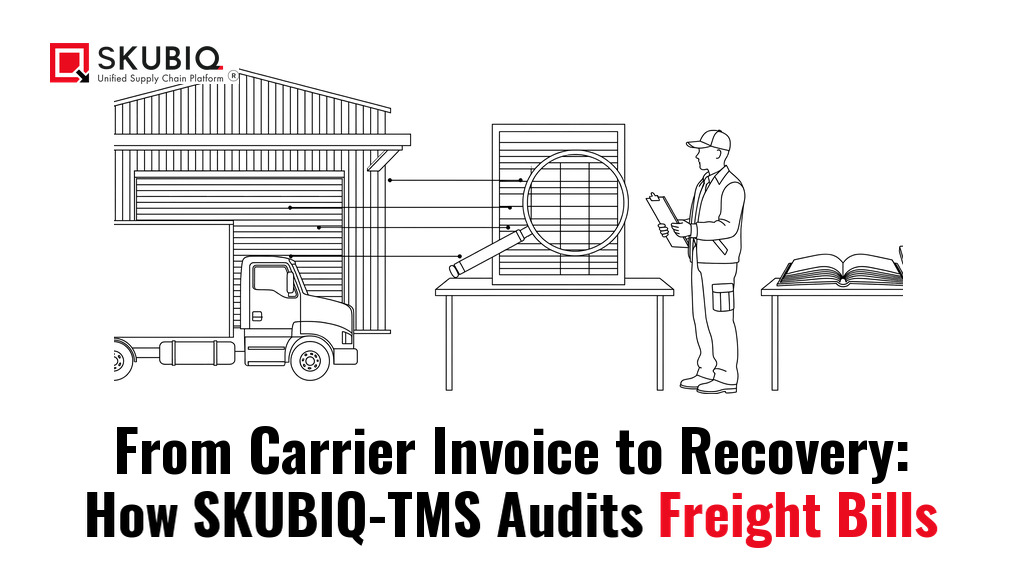
From Carrier Invoice to Recovery: How SKUBIQ-TMS Audits Freight Bills
A carrier invoice arrives after the truck has gone. It arrives as a PDF, it arrives in thousands, and it arrives with one instruction attached: pay this. The base freight is the part everybody expects. The rest of the bill is where the money quietly leaks - a fuel percentage calculated against the wrong index date, a detention charge for two hours nobody authorised, a toll line for a plaza the truck did not cross, a second invoice for a trip that was only ever billed once.
None of that is fraud, and most of it is not even carelessness at the carrier. It is the natural result of a settlement process where the thing being paid for is a piece of paper describing a journey, rather than the journey itself. Freight bill audit is the discipline of putting the paper back against the journey before the money moves.
The size of the gap is not small. TLI, a freight brokerage that runs its own audit programme, reports that industry estimates put freight billing error rates as high as 3% to 8% of invoices, and that its own shipment data shows 2% to 3% of invoices contain overcharges [TLI]. On the wider claim, WWEX reports the figure more starkly:
According to the Council of Supply Chain Management Professionals (CSCMP), approximately 80% of carrier invoices contain some type of discrepancy, with 15% to 20% of invoice inaccuracies resulting from carrier overcharges. - WWEX, citing CSCMP [WWEX]
Those two numbers are not comparable - one is a carrier's own book, the other is an industry survey quoted by a broker - and neither is a promise for your business. What they do establish is that discrepancies are the normal case, not the exception, which means checking is a process question rather than a crisis question. TLI also puts the prize on the table: most shippers recover 2% to 3% of annual freight spend through consistent pre-payment auditing [TLI].
The invoice is a claim, not a fact
Treat every carrier invoice as a claim with four things asserted in it: that a trip happened, that the trip was what was booked, that the price for it was the price agreed, and that the add-ons on top were earned. Each of those four assertions can be checked against records you already hold, which is the entire basis of the discipline. Redwood Logistics describes the method cleanly: four-way matching compares each invoice against the carrier contract, the shipment tender, the proof of delivery and the purchase order, and where all four align the invoice is approved automatically, while a mismatch sends it to review [Redwood Logistics].
The important word in that sentence is not matching. It is before. Redwood draws the distinction plainly: a pre-payment audit catches errors before you pay the bill, while a post-payment audit tries to recover overcharges after the money has already left your account [Redwood Logistics]. The same discipline is what SKUBIQ-TMS is built around on the billing side, where the transport record - the booking, the tender, the leg, the delivery proof - is the thing being reconciled rather than a separate spreadsheet assembled weeks later [SKUBIQ-TMS].
What a freight bill actually contains
Before you can audit a bill you have to know what is on it. An Indian road freight invoice is not one number. It is a base rate plus a set of add-ons plus tax, and every add-on is separately arguable. iThink Logistics puts the shape of it in a single line:
Freight bill = chargeable weight x rate + add-on charges + GST. - iThink Logistics [iThink Logistics]
That line is the audit in miniature. If the rate is wrong, the chargeable weight is wrong, or one of the add-ons was never authorised, the total is wrong - and the four inputs are checked against four different systems, which is why manual checking usually does not survive contact with a busy lane.
| Component | How it is normally set | Where it goes wrong |
|---|---|---|
| Base freight | Quoted per trip in India, built from distance, vehicle and lane - TruckGuru quotes per trip rather than per km, and a per-km figure is only an effective rate for comparison [TruckGuru] | A rate from an expired agreement, or a lane rate applied to the wrong distance |
| Toll | Either inside the trip fare or billed as an actual, based on a notified base rate per kilometre for the stretch and a multiplier for the vehicle class [Trucks India] | Charged twice, or billed for a different vehicle class than the one that ran |
| Fuel surcharge | A percentage tied to a published diesel price, on top of the base [FR8] | The wrong index date, or the wrong base rate the percentage is applied to |
| Driver allowance | A daily allowance on multi-day runs, usually quoted as a share of the trip cost - FR8 puts driver bata at about 15% of the trip cost in its worked example [FR8] | Charged for a trip that finished the same day, or paid on top of a rate that already contained it |
| Loading and unloading | An agreed amount per trip, typically negotiated separately [TruckGuru] | Billed at both ends when only one side was agreed |
| Detention / waiting | A free period, then a fee when the truck sits idle past it [TruckGuru] | No free time recorded, so the start of the charge cannot be evidenced |
| ODA and out-of-route | An out-of-delivery-area fee where the consignor address falls outside the served zone [iThink Logistics] | Raised on a delivery that was inside the agreed zone |
| GST | 5% without input tax credit or 18% with it for road freight by a goods transport agency [iThink Logistics] | Charged at the wrong rate, or charged where reverse charge applied |
Every row in that table is checkable, and every row is a place where the carrier's spreadsheet and yours disagree. That is why freight bill audit is a data problem before it is a negotiation problem.
The four documents every charge has to agree with
Four-way matching works because the trip leaves behind four independent traces. If all four say the same thing, the invoice is very probably right; if they disagree, you know exactly which question to ask. The documents are the same in an Indian road-freight operation, with Indian names.
| Document | What it proves | The check it supports |
|---|---|---|
| Rate confirmation / contract | What was agreed to be paid, and from which date | Base rate, minimum charge, surcharge percentages, free-time allowances, dispute window |
| Trip record | That the vehicle ran the booked route, and when it arrived and left | Distance billed, detention start, waiting time, number of trips |
| Proof of delivery | That the goods were delivered, to whom, and in what condition | Delivery date, POD validity, exceptions, short delivery claims |
| Invoice | What the carrier says it is owed | Every line, against the three records above |

The check itself, in four steps
- Pull the rate agreement that was effective on the pickup date - not the current one, and not the one the carrier quotes from.
- Pull the trip record: vehicle, driver, route, gate-in and gate-out times, and the accessorial authorisations raised for that trip.
- Pull the proof of delivery, and note the delivery timestamp and any exception recorded against it.
- Compare the invoice line by line against those three records, and route every difference to a named approver with a deadline attached.
In India the documentary spine of that set is statutory as well as commercial. The Central Board of Indirect Taxes and Customs requires that every registered person who causes movement of goods of consignment value exceeding fifty thousand rupees to furnish e-way bill information before the movement starts [CBIC, Government of India]. The person in charge of the conveyance must carry the invoice or bill of supply or delivery challan, as the case may be, together with a copy of the e-way bill or the e-way bill number, either physically or mapped to a Radio Frequency Identification Device embedded on to the conveyance [CBIC, Government of India]. Once generated, a unique e-way bill number is made available to the supplier, the recipient and the transporter on the common portal [CBIC, Government of India].
For an audit, that gives you something valuable: a number, issued before the goods moved, that both sides of the transaction hold. iThink Logistics sets out the rest of the Indian document set for a B2B consignment - the GST invoice, the packing list, the e-way bill, the lorry receipt and the proof of delivery - and notes that the POD is the receiver's signed acknowledgement while the goods receipt note is the buyer's record after checking quantity and condition [iThink Logistics]. Keep both until the invoice is settled; they are what a dispute is made of.
The six charges that fail most often
TLI, running the same routine across its own book, describes the pattern it flags: rate mismatches, duplicate invoices, unauthorised accessorials and incorrect fuel surcharges [TLI]. Redwood names the accessorial failure mode more bluntly: you get billed for services that were never approved or never performed [Redwood Logistics]. Both are pointing at the same weakness - the system has no record of what was authorised, so the carrier's version of events wins by default.

| Error | How it shows up on the bill | What settles it |
|---|---|---|
| Rate misapplication | The base rate is from a superseded agreement, or the lane rate is wrong | Contract version effective on the pickup date |
| Duplicate billing | The same trip appears on two invoices, or under two reference numbers | A trip register keyed on vehicle, date and route |
| Incorrect fuel surcharge | Wrong index date, or the percentage applied to the wrong base | The contract's surcharge table against the invoice line |
| Unauthorised accessorial | Loading, unloading, ODA or a handling charge nobody ordered | An authorisation log with a name and a time against it |
| Detention beyond free time | Charged hours that the arrival and departure timestamps do not support | Gate-in and gate-out timestamps, and the agreed free period |
| Toll mismatch | Billed for a plaza not crossed, or at the wrong vehicle class | The FASTag statement for the vehicle and the lane |
Detention: the charge your own dock creates
Detention is worth separating out, because unlike fuel or toll it is frequently created at the shipper's end rather than the carrier's. A typical invoice can include waiting or detention fees if the truck sits idle past an agreed free period [TruckGuru]. If the free period is never defined, and the arrival and departure times are never recorded against the vehicle, there is nothing to argue with - the carrier's number is the only number.
This is a scheduling problem before it is a billing problem. SKUBIQ-TMS treats it that way, with vendor dock slots scheduled and enforced so that congested yards become planned flow [SKUBIQ-TMS], and with geo-stamped ePOD, photo capture and e-signature so that every consignment closes with a delivery record rather than a memory [SKUBIQ-TMS]. SKUBIQ-WMS carries the same idea on the inbound side with Vehicle Outbound Dock Sequencing and Yard & Dock Management [SKUBIQ-WMS]. Fix the arrival window and the detention argument usually disappears on its own.
Toll, fuel and the surcharge you cannot check at a glance
Toll and fuel are the two lines that look smallest on the invoice and are hardest to verify by eye, because both are derived from a published number applied to a private fact.
On the fuel side, FR8 publishes a per-kilometre variable cost floor for a 16-tyre MXL on Indian highways: fuel at ₹19–24, toll at ₹3–7, tyre wear and maintenance at ₹3.5–5.5, giving a total variable cost of ₹26–37 per kilometre [FR8]. Its point is not that this is the rate - it is not, and FR8 says so - but that it is a floor: quotes significantly below ₹26/km in variable costs alone mean the operator is running toward a better return load or the rate will be renegotiated at loading [FR8]. A fuel surcharge line that does not survive that test is worth a query before it is worth a payment.
On the toll side, the structure is published and the application is what varies. Toll is calculated under the National Highways Fee rules from a base rate per kilometre notified for the stretch, the length of the tolled stretch the plaza covers, and a multiplier for the vehicle class [Trucks India]. For goods vehicles the class is set by axle count [Trucks India] - which makes the axle count on your own vehicle a billing input, and a vehicle substituted mid-trip a pricing event. Since 15 April 2026 the Fourth Amendment Rules charge overloaded vehicles on a tiered basis: no overload fee up to 10 percent excess, two times the base rate above 10 and up to 40 percent, and four times the base rate above 40 percent [Trucks India].
Three questions that settle most toll lines
- Was the toll already inside the trip fare? A rate that includes toll cannot also carry a separate toll line.
- Does the vehicle class on the invoice match the axle count of the vehicle that actually ran the trip?
- Does the FASTag total for the lane and dates match the toll line, plaza by plaza?
The verification route is unglamorous and works: your own FASTag statement is the real figure you actually paid, plaza by plaza, with dates [Trucks India]. For a fleet running a central FASTag account rather than letting drivers top up, it is the one document that matches what left the bank against what the carrier billed. SKUBIQ-TMS validates axle configuration, weight distribution and equipment matching before dispatch for exactly this reason - an overload discovered at the plaza becomes a four-times toll rate on a lane that was planned as something else.
GST, reverse charge and the invoice that should not have reached you
Tax is the line where an Indian freight bill is most often wrong, and where the error is structural rather than clerical. For road freight by a goods transport agency the rate is 5% without input tax credit or 18% with it, and the charge itself depends on the mode: under forward charge the transporter bills the GST, while under reverse charge the registered recipient pays it [iThink Logistics]. FR8 states the same framework from the shipper's side: under the GTA framework most B2B freight runs at 5% GST under RCM, you pay it directly to the government, and if you are GST-registered you claim it back as ITC so the net cost is zero - with shipments under ₹750 per consignee per day exempt [FR8].
Two audit questions follow. First, was the invoice even supposed to carry GST? A bill issued by a transporter under reverse charge when the recipient is the liable party is a credit-note problem, not a rounding problem. Second, is the rate the one that applies to that particular consignment and that particular credit position? Neither question is answerable from the invoice alone; both are answerable from the e-way bill, the invoice and your GST registration in one sitting.
Pre-payment or post-payment: the timing decides the money
The timing of the audit is worth more than the sophistication of the tooling. Pre-payment audit protects cash flow and avoids drawn-out recovery disputes; post-payment audit means the overcharge has already been funded, and recovery becomes a negotiation with a carrier who now has leverage and a window [Redwood Logistics].
One caution about deadlines, because the most-cited number in this field comes from another jurisdiction. Federal regulations generally allow up to 180 days to file certain freight overcharge claims under the Carmack Amendment, although carrier-specific requirements and contractual terms may vary [WWEX]. That is US law. In India the window that binds you is the one in your contract or your carrier's terms, and the practical constraint is different: the documents a dispute needs - POD, lorry receipt, e-way bill, authorisation record - get harder to find every week the invoice sits unchallenged. Treat the dispute window as a retention policy for evidence, not only as a deadline.
Tolerance rules that keep your team out of noise
If every invoice is examined, nobody examines them. Redwood describes the mechanism that makes it work: a tolerance threshold is a small variance you choose to accept automatically to avoid processing friction - auto-approving a discrepancy under five dollars, for example, because the labour cost to investigate it would exceed the savings - while anything above the threshold becomes a hard stop requiring human review [Redwood Logistics].
The threshold should not be a single number. A percentage threshold behaves very differently on a ₹20,000 trip and on a large one, and a flat rupee threshold does nothing on the small invoices that arrive in bulk. A workable rule set has at least three bands: an automatic pass below a small absolute amount, a percentage test above it, and a named-approver route for anything that fails either test or that touches an accessorial charge - because an unauthorised detention fee is a process failure worth fixing, not just a rupee amount worth netting off. SKUBIQ-TMS is built for this shape of work: trip-based invoicing with per-km and GRM reconciliation and fuel and accessorial claim handling with dispute workflows means the exception is a case with a status rather than an email with a subject line [SKUBIQ-TMS].
Disputes that actually get paid
WWEX describes the recovery path in six steps, and the shape of it matters more than the words: billing discrepancy identified, supporting documentation gathered, dispute submitted to the carrier, carrier reviews the claim, credit or invoice adjustment issued, root cause documented [WWEX]. Two of those steps are the ones teams skip. The documentation step is what makes the difference between a claim and a complaint - WWEX lists the original freight invoice, the bill of lading, the proof of delivery and the contract or negotiated rate agreement as the documents that have to travel with the dispute [WWEX]. The root-cause step is what stops the same claim being raised every month.

The commercial discipline is to hold the payment until the invoice is verified. TLI describes what that looks like in practice: every invoice is reviewed before it reaches accounts payable, discrepancies are flagged and disputed directly with the carrier before payment, and payment is released only on verified invoices [TLI]. In a multi-tenant 3PL that discipline has to be per tenant - SKUBIQ lists multi-client billing and a single multi-tenant ledger that every booking, tender, leg and invoice runs against [SKUBIQ-TMS], and the pricing page lists 3PL Billing as a per-tenant add-on [SKUBIQ WMS pricing].
What to measure: the audit KPI set
Audit programmes die without four numbers. Redwood names the first three directly - invoice accuracy rate, which is the share of invoices that pass validation on the first pass; exception rate, the share routed to the exceptions queue; first-pass yield, the share processed without any manual intervention; and recovery rate, the dollar value of overcharges identified and recovered [Redwood Logistics]. The fourth is worth adding for a transport operation because it is the one that predicts the others: the accessorial share of the bill, the proportion of freight spend sitting in charges that were never part of the agreed rate.
| KPI | What it measures | What a bad number means |
|---|---|---|
| Invoice accuracy rate | Share of carrier invoices that pass validation on the first pass | Your source data is weaker than you think, or the review is not happening |
| Exception rate | Share of invoices routed to the exceptions queue | A rising number means the carrier's billing behaviour changed, or your volume outgrew the review |
| First-pass yield | Share of invoices processed with no manual intervention | Below the level where manual review is worth the effort |
| Recovery rate | Value of overcharges identified and recovered, as a share of freight spend | The gap between what is found and what is actually claimed back |
| Accessorial share | Share of the bill made up of charges outside the agreed rate | A high number is a dock and appointment problem as much as a billing problem |
| Dispute ageing | Days open on each dispute, and the share closed by credit | Ageing disputes are the ones being written off |
Report them monthly, per carrier and per lane, not per company. Redwood's advice to track root causes by carrier, lane or charge type is what turns an audit from a cost centre into a negotiation position [Redwood Logistics].
SKUBIQ-TMS: reconciliation built into the transport record
Every step above is the same idea seen from a different angle: the audit is cheap when the evidence was captured at the time the work happened, and expensive when it has to be reconstructed from documents nobody assembled on the day. A transport management system that holds the booking, the tender, the leg, the delivery proof and the invoice in one record makes the comparison a query rather than a project.
That is what SKUBIQ-TMS is built to do. Its billing and settlement layer covers trip-based invoicing, per-km and GRM reconciliation, and fuel and accessorial claim handling with dispute workflows; the delivery side closes each consignment with geo-stamped ePOD, photo capture, e-signature and exception handling [SKUBIQ-TMS]. For a warehouse feeding that transport record, SKUBIQ-WMS provides the other half of the evidence - Load Based Invoice Generation, Batch & Lot Level Traceability, Comprehensive Audit Logs, and Yard & Dock Management for the appointment that keeps detention off the bill [SKUBIQ-WMS].
Where each piece of evidence comes from
- The rate: the agreement, the lane and the vehicle class, held against the booking rather than against a spreadsheet of last year's lanes.
- The trip: the tender, the planned route and the legs actually run, with gate-in and gate-out times captured at the dock.
- The delivery: a geo-stamped ePOD with photo capture and e-signature, so the delivery timestamp is a record rather than a recollection.
- The invoice: generated from the trip and the rate, with every accessorial raised as a claim that can be accepted, disputed or written off.
Three practical consequences follow. First, the warehouse and the transport record have to share a SKU, a quantity and a unit of measure, which is what the [SKUBIQ SaaS WMS for India] deployment is for. Second, the people who approve an accessorial charge at the dock are the people whose name ends up on the audit trail, so authorisation becomes part of the shift rather than an email - which is the same discipline SKUBIQ-LMS applies to agency staff, who are onboarded, certification-checked and timesheet approved before the first shift [SKUBIQ-LMS]. Third, freight cost has to reach a dashboard next to the labour cost it is bought with, or it will be discussed as a number rather than a behaviour.
For a team deciding what to put in place first, the [SKUBIQ FAQs] answer the product questions, the [SKUBIQ support team] answers the implementation ones, and the [SKUBIQ contact page] is where a lane-by-lane reconciliation walkthrough starts.
Freight is audited, not absorbed
There is a version of freight management where every invoice is paid, the transport cost lands in the P&L as one line, and nobody knows whether it was right. It is comfortable and it is how most Indian shippers and 3PLs still work, because the alternative - a check on every bill - looks like a tax on everyone's time until it is compared with the size of the error itself.
The discipline is simpler than it sounds. Hold the rate contract, the trip record, the proof of delivery and the invoice side by side. Set a tolerance below which nobody argues. Escalate the rest with the document that proves it. Fix the cause, which is usually a dock appointment or a missing authorisation, and not just the amount. Then do it again on the next lane.
That loop is not an extra system. It is what a transport record is for - and the reason SKUBIQ-TMS treats billing and settlement as part of the trip rather than as a department at the end of it.