
From Warehouse Operations to 3PL Billing: How SKUBIQ Simplifies Pallet and Volume-Based Billing
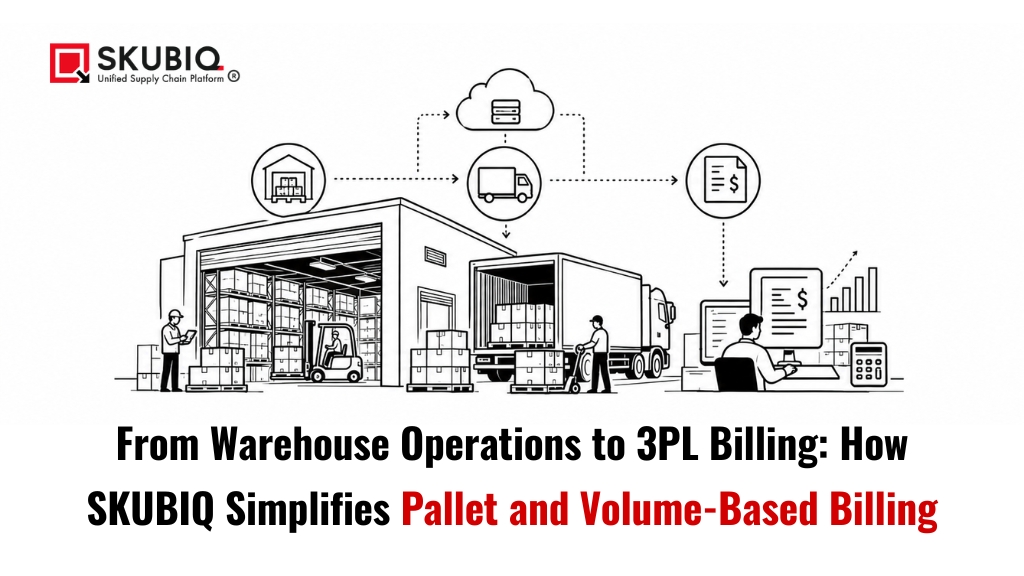
In today’s 3PL industry, warehouse management is about more than inventory control. Logistics providers must accurately convert warehouse activities into transparent, customer-specific billing. Managing storage, handling, inbound, outbound, and value-added services across multiple clients can quickly become complex when calculations are performed manually.
The Challenge of 3PL Billing
Many 3PL operators still rely on spreadsheets and disconnected systems to calculate customer charges. This often leads to:
-
- Billing discrepancies
-
- Manual reconciliation efforts
-
- Limited visibility into customer-wise inventory
-
- Higher risk of calculation errors
-
- Customer disputes over warehouse charges
To achieve accurate billing, warehouse operations and billing data must be connected.

How SKUBIQ Helps
SKUBIQ WMS provides tenant-wise visibility of inventory and operations, creating a strong foundation for 3PL billing.
For every customer, SKUBIQ can track:
-
- Inventory stored
-
- Inbound and outbound transactions
-
- Warehouse occupancy
-
- SKU movement
-
- Storage duration
-
- Operational activities
This allows 3PL providers to answer critical billing questions:
-
- What inventory was stored?
-
- How much space was occupied?
-
- How long was it stored?
-
- How many pallets were received or dispatched?
-
- Which customer consumed warehouse capacity?
Supporting Multiple Billing Models

Pallet-Based Billing
Many 3PL contracts charge customers based on pallet occupancy.
SKUBIQ captures pallet-level inventory and transaction data, enabling billing based on:
-
- Daily pallet occupancy
-
- Average pallet count
-
- Opening or closing pallet balance
-
- Maximum pallet utilization
Volume-Based Billing
For customers storing cartons, boxes, or loose inventory, billing may be based on:
-
- CBM (Cubic Meter)
-
- Weight
-
- Units
-
- Cartons
-
- Boxes
By maintaining product dimensions and inventory quantities, SKUBIQ provides the operational data needed for volume-based billing calculations.
The Power of UOM Management
Accurate billing starts with proper Unit of Measure (UOM) configuration.
For example:
-
- 1 Box = 100 Pieces
-
- 1 Pallet = 20 Boxes
-
- 1 Pallet = 2,000 Pieces
With a structured UOM hierarchy, SKUBIQ can support billing based on:
-
- Pallets
-
- Boxes
-
- Pieces
-
- Volume
-
- Weight
This flexibility allows each customer’s contract requirements to be accurately managed.
From Warehouse Activity to Billable Data

Every warehouse transaction creates operational data that can support billing.
Inbound → Putaway → Storage → Picking → Outbound
At every stage, SKUBIQ records:
-
- Customer ownership
-
- SKU details
-
- Quantities
-
- Storage locations
-
- Transaction dates
-
- Inventory movements
This creates a traceable link between warehouse operations and customer invoices.
Customer-Wise Billing Visibility

For multi-client warehouses, SKUBIQ enables customer-specific reporting such as:
-
- Inventory by customer
-
- Pallet occupancy by customer
-
- Inbound and outbound activity
-
- Warehouse utilization
-
- Storage history
This improves transparency and simplifies invoice reconciliation.
Why Accurate Operations Drive Accurate Billing
Reliable billing depends on reliable warehouse data.
The formula is simple:
Accurate Transactions → Accurate Inventory → Accurate Utilization → Accurate Billing
When warehouse activities are recorded correctly, billing becomes more transparent, auditable, and dispute-free.
Conclusion
SKUBIQ is more than a Warehouse Management System. It provides the operational foundation required for modern 3PL billing by connecting inventory, warehouse transactions, UOM management, tenant tracking, and customer-specific billing rules.
Whether billing is based on pallets, volume, weight, or transactions, SKUBIQ helps 3PL providers build a structured, transparent, and scalable billing framework.
The key principle is simple: Capture warehouse operations accurately, apply customer-specific billing rules, and generate billing data that is fully traceable back to warehouse activity.